

See how firmware actually makes hardware do something - a button, a firmware decision, a driver circuit, and why an accepted request is not the same as a confirmed result.
Open an embedded product's source code and you will not find a line that says turn on the light. What you will find is a line closer to request ON - and between that request and an actual beam of light, or a window that actually moves, sits a whole chain of hardware most learners never think about until something stops working. Understanding how firmware controls hardware starts with keeping those two things - the request and the result - clearly separate.
What firmware actually is
Firmware is the software that runs inside an embedded product - stored instructions a processor executes, not the physical chip itself, and not something permanently frozen the day the product shipped. A microcontroller's processor fetches those instructions and carries them out; the direct result of that execution is a request, not yet a physical effect. Firmware can often be updated, which is exactly why the same hardware can behave differently after a firmware change - the chip did not change, the instructions it runs did.
Follow a request through a power-window button
Picture a car's power-window switch.
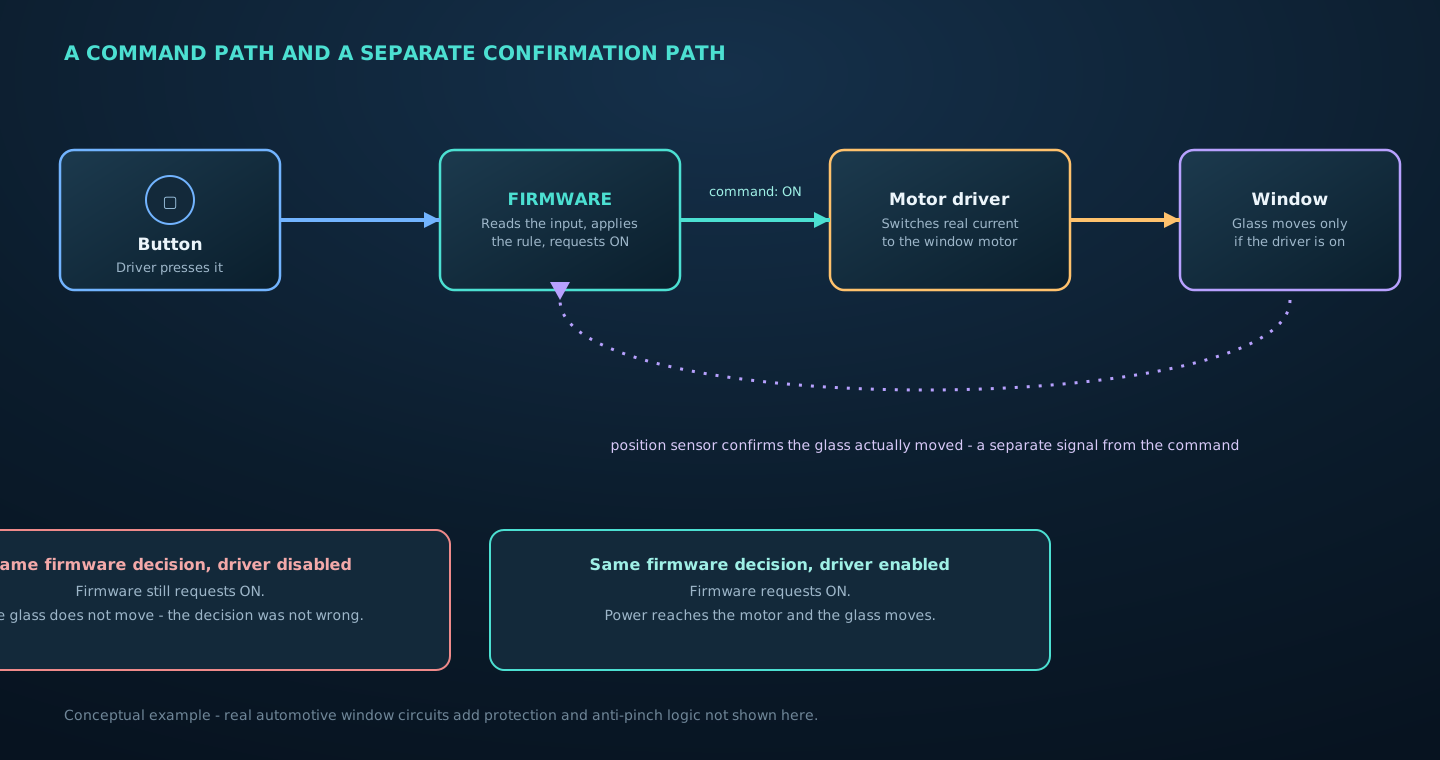
- Button — a mechanical input a person presses; the button's state is data, not firmware.
- Firmware — reads that input, applies its rule ("hold means run"), and requests ON from the hardware interface that controls the motor.
- Motor driver — a hardware interface that switches real current to the window motor once its own conditions are met.
- Window motor — turns electrical power into the physical motion that actually moves the glass.
Firmware's job stops at the request. It is the driver circuit and the motor that do the physical work - firmware only decides what should happen and asks the hardware to do it.
The command path and the confirmation path are different things
This is the one idea worth remembering from this chapter: an accepted software request is not proof of a physical result. Firmware can request ON correctly, every single time, and the window can still fail to move - because the driver is disabled, the motor has no power, or a connection is broken somewhere in between. The firmware's decision did not change; a dependency in the physical path did.
Want to understand how this works internally? Explore real execution flows, practical scenarios, debugging and assessments through DIVE2CORE.